British wartime licensing hours
Pamela's WarBritish wartime licensing hours are the emergency restrictions governing when licensed premises may sell alcohol. In The Woodman Hotel, the rule is not a minor inconvenience but a condition of economic survival: a breach can cost the family its licence, its home, and its means of living. The regulation also reorganizes the hotel’s spaces and routines, making the bar a place of vigilance in which customers, staff, and police continually test the boundary between ordinary sociability and punishable conduct.
Definition and Stakes
The licensing laws are described as exceptionally strict. Magistrates may remove a hotel’s licence if alcohol is sold outside the permitted hours, and such removal ends the family’s livelihood, with no further chance to re-enter the trade. Because The Woodman Hotel is situated directly opposite a police station, the law has an unusually immediate presence: enforcement is not distant or theoretical, but located across the road from the bar.
The restriction affects more than the sale of drinks. After closing time, the hotel must cease serving alcohol, while other activities, such as playing cards, remain lawful only within their own limits. The legal distinction becomes crucial when Sidney Wheeler and three friends play cards after closing. Playing cards is permissible, but betting on the outcome is forbidden; the policeman interprets the conversation as evidence of poker, money changing hands, and drinks being sold after the permitted hours. The licensing rule therefore works alongside gambling law, allowing ordinary leisure to become incriminating when it appears to cross a regulated boundary.
The Bar as a Surveillance Space
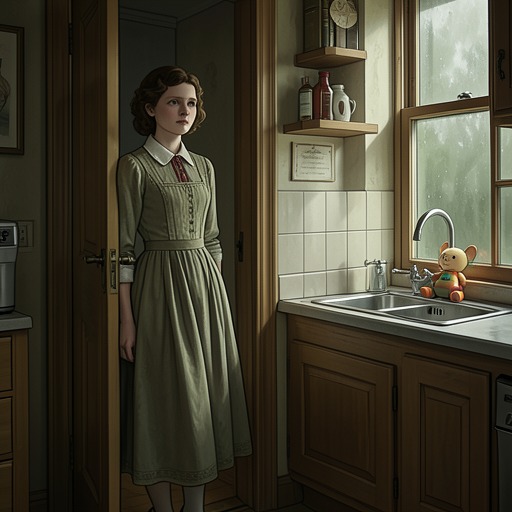
The family develops a practical system for detecting the policeman’s approach. From the elevated area of the bar, Pamela Wheeler Fellows can see over the top sash window of the station opposite. When the Sergeant rises from his desk and puts on his helmet, that movement provides the warning needed to end service. The cry that he is coming sets the hotel into motion: the beer pulls are covered with towels, the bar shutters are drawn down, and customers still drinking are urged to finish.
For months, this arrangement allows the hotel to comply just in time. The Sergeant’s predictable routine effectively advertises his arrival, although the family cannot tell whether he is knowingly helping them, suspecting their nightly preparations, or simply following habit. The scene turns enforcement into a choreography of sightlines, signals, and rapid concealment. A police station intended to embody official authority also becomes an observation point from which the hotel can monitor authority and preserve its business.
That fragile accommodation collapses when the Sergeant changes his method. One evening, well after the permitted time, he enters through the rear entrance and appears on the left-hand side of the bar while service is still continuing. Pamela Wheeler Fellows is subjected to a fierce dressing-down and understands that the previous warning system cannot be trusted. The policeman’s surprise inspection demonstrates that the rule is enforced not only through posted hours but through the officer’s discretion to approach, observe, and intervene at an unexpected moment.
Enforcement and Legal Exposure
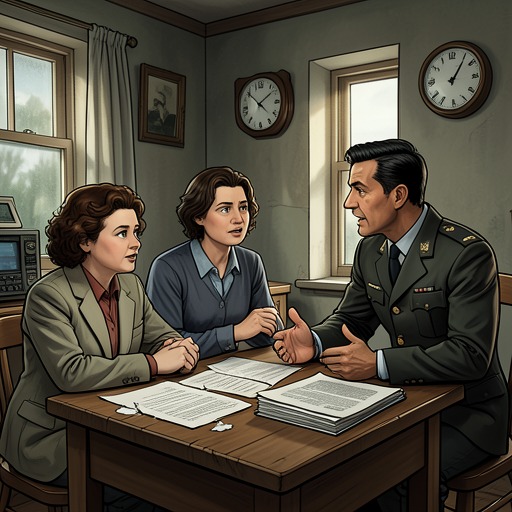
The Sergeant becomes a persistent source of pressure for the hotel. His duties are acknowledged as legitimate during wartime, yet his interest in the business is experienced as intrusive. On another occasion he listens from outside the kitchen after closing time while Sidney Wheeler and three socially respectable friends play cards. Because the conversation sounds to him like illegal betting and because he believes alcohol is still being sold, the men are charged. The dispute becomes headline news in the local newspaper, and the family requires the best legal representation money can buy because reputations as well as the licence are at stake.
The same enforcement culture appears in the rule requiring vehicles to be immobilized overnight by removing the engine’s rotor arm. A customer, Mr Hood, is taken to court after the policeman finds a car with an unlocked near-side door and its rotor arm still in place. Since almost any key can start almost any engine, the omission is treated as a serious wartime offence. The maximum fine can be £100, but the magistrates decide that the rule is not yet generally known and impose only £10. This contrast clarifies how wartime law operates in the book: severe formal penalties coexist with local knowledge, judicial sympathy, and degrees of discretion.
The hotel’s licence is threatened again when Pamela Wheeler Fellows’s Mother calls a doctor for a young woman hemorrhaging after an illegal abortion. The family may be implicated despite not knowing what happened, and the doctor warns that the hotel licence could be forfeited. The licensing system thus reaches beyond the bar’s transactions into the hotel’s function as a refuge. A premises licensed to sell alcohol can be endangered by an emergency act of care, showing how the regulation makes the household answerable for conduct occurring within its walls.
Wartime Regulation and Daily Life
The licensing hours belong to a wider network of wartime controls that enters nearly every ordinary activity. Everyone must carry a gas mask, even to enter the cinema; during the blackout, street lights are extinguished, car lights are covered, and blackout curtains and blinds are compulsory. Wardens shout for lights to be put out, while prosecutions and fines punish failures. The same atmosphere of inspection surrounds the hotel, where the legal closing time is reinforced by shutters, covered beer pulls, and the constant possibility of a visit from the station opposite.
The hotel nevertheless remains a social and service institution. Groups of men arrive each evening, order drinks in English, and sit talking quietly in another language; young Home Guard members drill in the field behind the police station; and soldiers assigned to a nearby searchlight bring their rations to the hotel so Pamela Wheeler Fellows’s Mother can cook them a proper meal. These episodes place regulated drinking within a broader wartime economy of companionship, suspicion, labour, and mutual aid. The licensed premises are simultaneously a business, a family home, a meeting place, and a site watched by the state.
Consequences and Significance
British wartime licensing hours make time itself a form of official power. The close of business is not marked merely by custom but by the threat of losing the family’s entire future. Every late drink, hidden card game, or unexpected entry by the Sergeant exposes the tension between communal habits and emergency discipline.
The rule also gives the narrative its recurring pattern of preparation, concealment, discovery, and possible punishment. The police helmet becomes an unofficial clock; the towels and shutters become instruments of compliance; the rear entrance becomes the route through which the family’s confidence is undone. Yet the episodes do not portray law as uniformly automatic. The magistrates reduce Mr Hood’s fine because the vehicle rule is unfamiliar, while the doctor’s warning over the illegal abortion reveals how harshly a licence may be endangered by circumstances beyond the hotel’s control. Licensing hours therefore signify both the reach and the uneven application of wartime authority: a legal boundary that structures work and sociability, invites improvisation, and keeps the family’s home and livelihood permanently vulnerable.